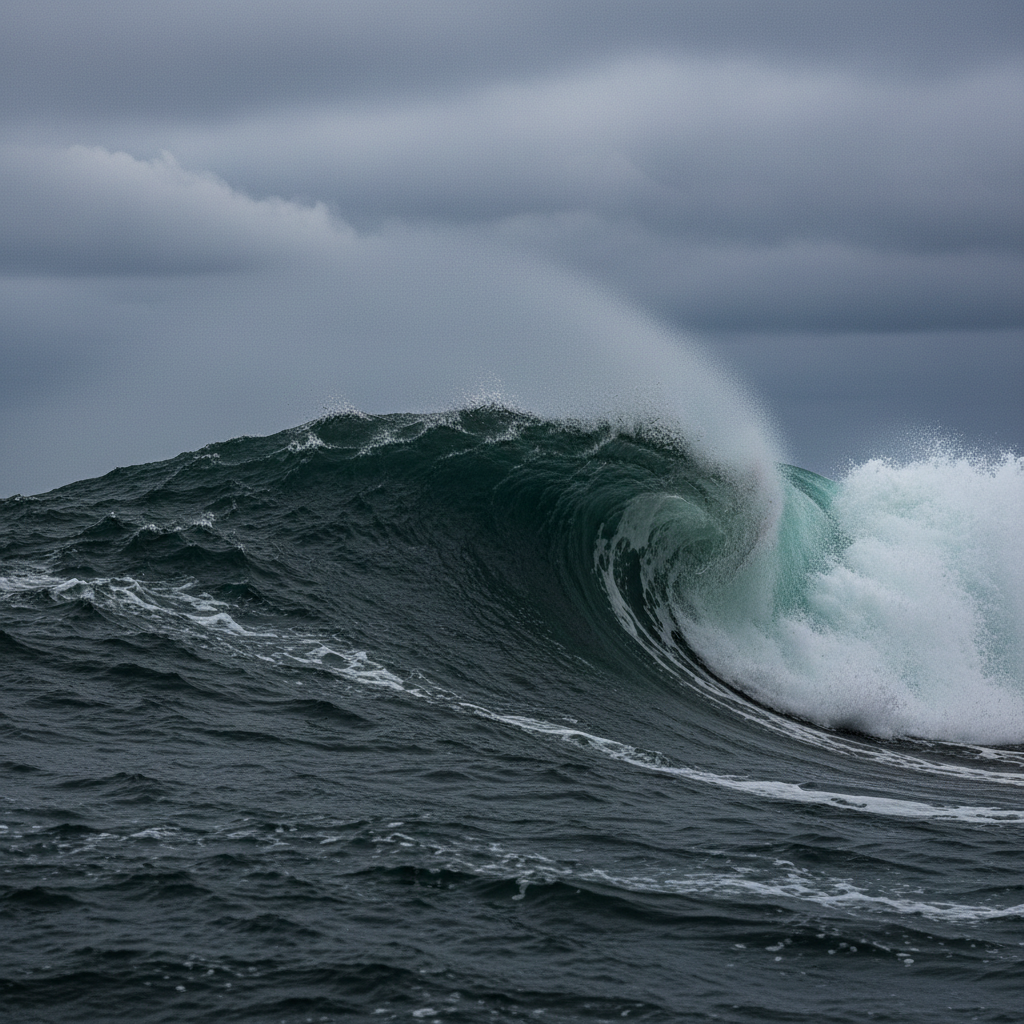
There is something about the sea that refuses to leave us alone.
Perhaps it is the endless movement, the changing light, or the extraordinary contrast between tranquillity and violence. One moment, the water appears almost motionless, reflecting the sky like a sheet of glass. The next, it becomes a restless, formidable force, capable of reshaping everything in its path.
For an artist, the sea presents an irresistible challenge. How do you capture something that never stands still? How do you translate its movement, its sound and its raw energy onto a motionless canvas?
These are questions I intend to explore over the coming months, and one artist whose work provides a particularly powerful source of inspiration is Maggi Hambling.
Referenced work
Maggi Hambling — The Wave
Fitzwilliam Museum, Cambridge
View at the Fitzwilliam MuseumMaggi Hambling —
Painting Beyond the Horizon
Born in Suffolk in 1945, Maggi Hambling has established herself as one of Britain's most distinctive and uncompromising contemporary artists.
Although widely recognised for her portraits and sculptures, it is her extraordinary relationship with the North Sea that particularly interests me.
Her seascapes are not conventional representations of coastal scenery. There are no picturesque sailing boats or carefully composed views intended simply to please the eye. Instead, Hambling confronts the sea in all its unpredictability. Her paintings seem to surge, twist and break across the canvas. Thick applications of paint, sweeping gestures and dramatic contrasts of light and darkness create an almost physical sense of movement. They are paintings that demand to be experienced rather than merely observed.
When the Sea Became the Subject
Hambling's celebrated series of North Sea paintings began in 2002, following her experience of a dramatic storm along the Suffolk coast.
The experience proved so compelling that she returned to her studio and transformed a small portrait she had been working on into a painting of the storm, drawing upon the intensity of what she had witnessed.
What fascinates me about this story is the spontaneity of the decision. The subject was no longer something she had carefully planned. It was something that had taken hold of her imagination and demanded expression.
There is an important lesson in that for any artist: sometimes the most compelling work emerges when we allow ourselves to respond instinctively, rather than rigidly following our original intentions.
"The wave becomes a moment of extraordinary tension: a towering mass of energy suspended between formation and collapse."
Referenced work
Maggi Hambling — Walls of Water
National Gallery, London
View at the National GalleryThe Wave as Subject
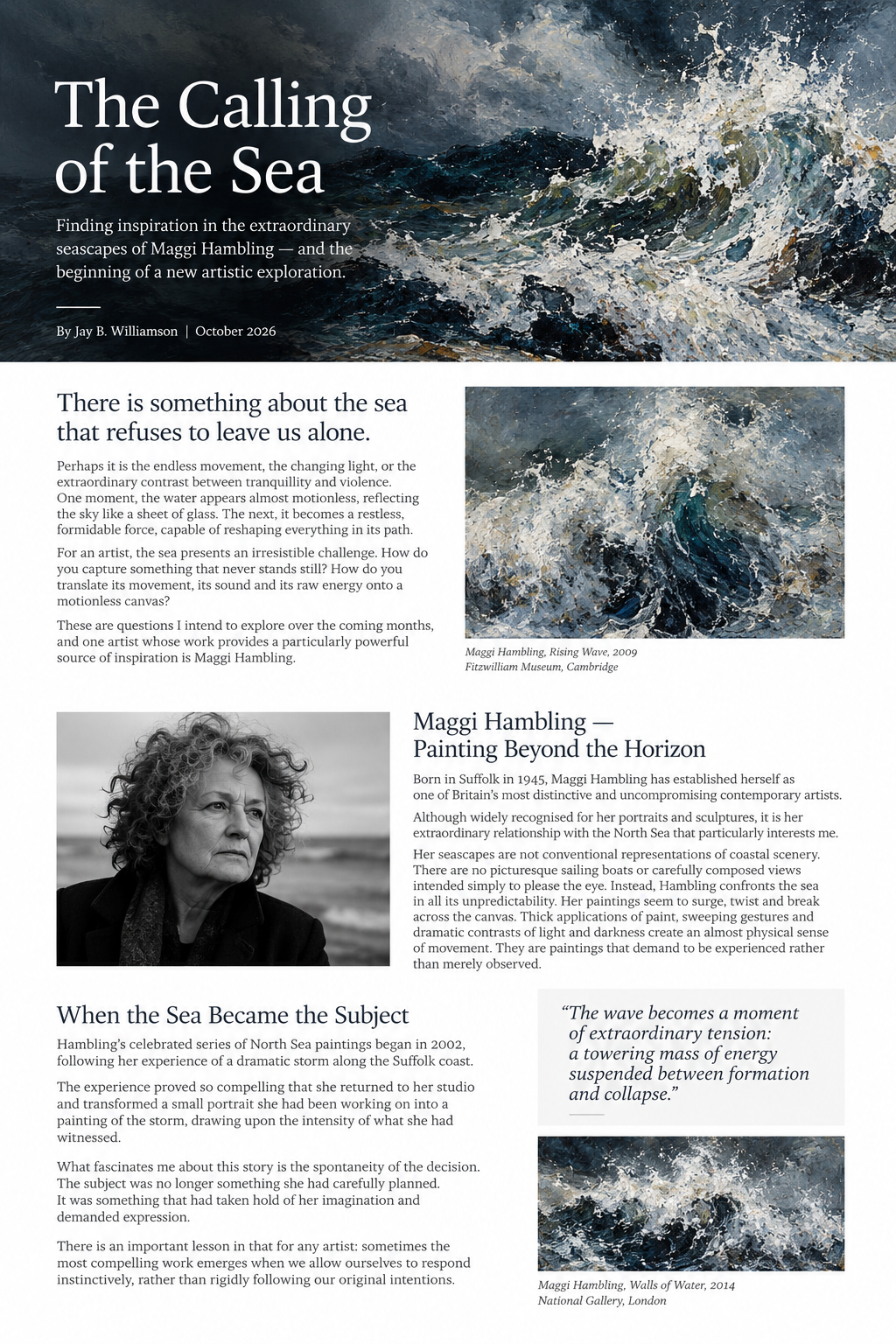
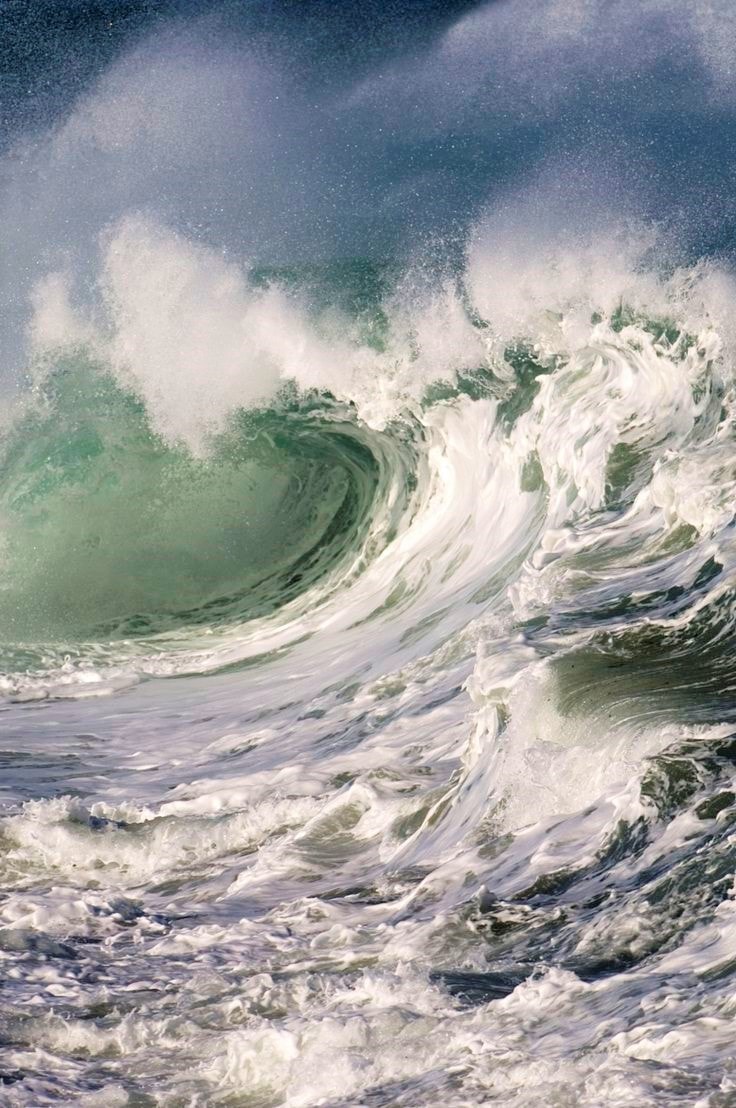
What strikes me most about Hambling's wave paintings is the way she treats the wave not as a static object but as an event — a moment of extraordinary tension between formation and collapse.
There is something almost theatrical about this. The wave is always in the process of becoming something else. It is never finished. And yet Hambling manages to arrest that process on the canvas — to hold the moment of maximum energy without freezing it.
Yet the sea's extraordinary power is not always expressed through crashing waves or violent storms. There is an equally compelling drama in its stillness: a seemingly endless horizon, the subtle movement of water beneath a changing sky, and the quiet tension of a sea that appears almost motionless. What I find particularly inspiring is the ability to communicate both extremes — tranquillity and turbulence — through the language of paint. Sometimes the quietest sea can evoke the strongest emotions.
This is, I think, one of the most difficult things an artist can attempt. And it is what makes her seascapes so compelling.
Texture, Surface and the Language of Paint
One of the things I find most instructive about Hambling's approach is her use of paint as a physical material rather than simply a means of representation.
Her surfaces are built up in thick, gestural layers. The paint itself carries energy — you can see the speed of the brushstroke, the pressure of the palette knife, the direction of movement. The texture of the painting becomes inseparable from its subject.
When I look at her wave paintings, I am not just seeing a representation of water. I am seeing the physical record of an encounter with water — the artist's body responding to what she witnessed, translated directly into the surface of the canvas.
This is something I want to explore in my own work. Not imitation — that would be pointless — but a deeper engagement with the physical properties of paint as a way of capturing movement and energy.
Inspiration: An Artistic Tradition
Throughout history, artists have shared their work, exchanged ideas and drawn inspiration from one another. Entire artistic movements have emerged from these creative relationships.
I see my admiration for Maggi Hambling's seascapes as part of that same tradition. Her paintings have awakened a desire to explore the sea through my own artistic language.
What emerges will undoubtedly be different, but that is precisely the point.
Inspiration is not replication; it is the beginning of another creative journey.
Beginning the Exploration
Over the coming months, I intend to develop a new body of work responding to the sea — its movement, its light, its capacity for both stillness and violence.
Hambling's work will be one point of reference among many. I am also drawn to the seascapes of J.M.W. Turner, the coastal paintings of Winslow Homer, and the more recent work of artists who have found in the ocean a subject that resists easy resolution.
But the primary source will be the sea itself. I plan to spend time on the coast — watching, sketching, absorbing — before I begin to paint. The work needs to come from direct experience, not from photographs or second-hand impressions.
I will document the process here as it develops. If you are interested in following the work, or in discussing the themes it raises, I would be glad to hear from you.
Further Reading
If you would like to explore Maggi Hambling's seascapes further, the following resources are a good starting point: